You’re Using Clickbait Wrong: The Value-First Sweet Spot That Actually Converts
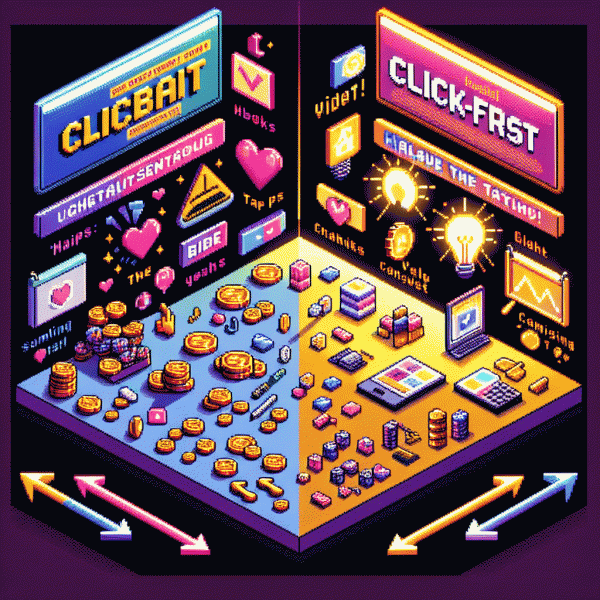
Hook ’em fast, keep ’em longer: the two-beat content rhythm
Think of your content as a mini song: a sharp opening lick, then a groove that makes people stay. The opener must lift eyeballs in the first swipe; the follow-through hands them something useful so curiosity becomes time spent, not a quick bounce.
Start with a micro-promise: a surprising stat, a bold image, or a question that highlights a real pain. Keep language elastic—short verbs, vivid nouns. Test hooks that are concrete ('Increase open rate 24%') rather than vague ('Get better results'), and time them to platform scroll speed.
The second beat is where you pay the listener. Deliver the promised insight in small, snackable chunks: one clear example, one quick how‑to, one tiny proof. Use numbered steps, a screenshot, or a mini case to convert curiosity into trust and make the next action feel natural.
- 🆓 Hook: Open with a specific surprise or question that creates a gap.
- 🚀 Deliver: Give one useful tactic or stat that solves the gap fast.
- 💥 Scale: Add a quick proof or next step that invites deeper engagement.
Measure retention metrics, not vanity. A/B test openings against the same follow-through and watch where viewers fall off. When the hook and the payoff perform as a duet, you stop chasing clicks and start building real conversions.
Clickbait without the ick: curiosity that keeps its promise
Curiosity is a tool, not a trap. The trick is to create intrigue that promises and then delivers value. If your headline hints at a payoff, the content must hand that payoff over quickly. Think of curiosity as a handshake: an interesting opener that pulls the reader in and then proves worth so they stay.
Use benefit-first curiosity lines: tease a specific result, give a timeframe, or name an unexpected mechanism. Swap vague hooks like You will not believe this for precise hooks such as How one tweak cut onboarding time by 40% in 7 days. Specificity removes the ick and raises trust while preserving curiosity.
Deliver the promise within the first few paragraphs with a micro takeaway. Lead with the result, then show the core step and one tiny example. If the reader can walk away with a single actionable move, the headline feels earned. Add a one-line summary near the top to increase perceived value and reduce drop off.
Measure beyond clicks: track time on page, scroll depth, and the conversion tied to the promised benefit. Run A/B tests swapping curiosity level and specificity and keep the version that sustains engagement, not just gets clicks. In short, flirt with mystery but follow it with substance, and your curiosity will actually convert.
Proof beats hype: numbers, specifics, and social receipts
Stop promising miracles and start showing receipts. Numbers and specifics are the oxygen of persuasive content: exact percentages, timeframes, and sample sizes. Replace vague claims like "skyrocketed" with a concrete line such as "increased CTR from 1.9% to 3.7% over a four-week A/B test with 12,345 impressions." That kind of specificity gives readers something they can believe and replicate.
Social proof matters, but format matters more. Instead of a bland testimonial, present the metric, the context, and the source: for example, "Organic shares: 1,200 (7-day), campaign: new product launch, audience: 45k email subscribers." Those details function as social receipts — they lower skepticism and make the claim actionable for a busy reader.
Make proof action-oriented: always pair the stat with the next step. Run micro-tests, then report the hook, the CTR, and the conversion delta. If Headline A yields 2.4% CTR and 0.9% purchase rate while B yields 3.6% CTR and 1.3% purchase rate, recommend switching to B and outline the creative tweak to test next. Showing the decision path is how proof turns curiosity into clicks.
Finally, package receipts into reusable assets. Build a simple library of "proof cards" that include the claim, metric, timeframe, and the one-sentence method used. When crafting a subject line or social post, pull a card and let the numbers carry the message. Honesty backed by specifics converts better than the boldest hook without evidence.
The bounce trap: spot empty clicks—and fix them fast
Clicks that look good on paper but lead nowhere are not a mystery, they are a signal. When CTR is high and conversions are low, you are collecting attention, not action. Look for short session durations, minimal scroll depth, repeated exits from the same page, and traffic from misaligned creatives or keywords. These are the fingerprints of an empty click.
Start with a fast triage. Segment by source and device, compare headline language to landing copy, and watch a handful of session replays. If most users spend less than 10 seconds or do not reach the first content block, treat the visit as a non engagement and prioritize fixes that address the top of the page.
Fixes are low tech and high impact when they focus on immediate value. Lead with the answer in the first screen, add a clear micro CTA, cut extra form fields, and surface trust signals near the top. Improve load time, match the ad promise word for word, and give mobile users a simplified path. Small shifts to the first impression convert curious clicks into willing skimmers.
Then test. Run a headline plus above the fold experiment, measure time to first meaningful interaction, and move budget to creatives that generate engaged sessions rather than just views. Treat those early seconds as sacred real estate and you will turn shallow curiosity into measurable outcomes. Quick triage, quick fixes, and ruthless testing will close the bounce trap fast.
Steal these headline templates for value-packed clicks
Think of headlines as a currency: they buy attention, but only if they promise something real. Use templates that trade intrigue for immediate utility—numbers, time, and a clear payoff. Below are compact, plug-and-play options you can adapt so curiosity turns into a useful click.
Drop one of these into a social caption, subject line, or landing headline and tweak the variables (number, time frame, audience). Each is built to telegraph benefit and reduce cognitive load:
- 🆓 Checklist: 7-step checklist to audit your funnel in 15 minutes
- 🐢 Fix: Quick fix to stop a common slow leak that kills conversions
- 🚀 Framework: 3-part framework to double output without more hours
Customize fast: swap in a real metric, add a tight time promise, and qualify with a source or result. Lead with an active verb, keep it short, and never bury the payoff behind adjectives.
Run two variants, measure CTR and downstream actions, then reinvest in the winner. Small, precise promises win—because value-first headlines attract clicks that actually convert. Try one now and iterate based on real signals.