Stop Scrolling: The Clickbait-vs-Value Secret That Skyrockets Conversions
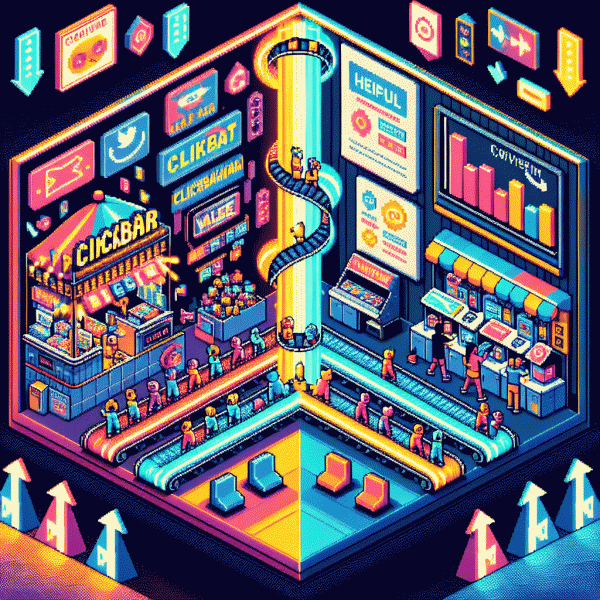
Hook Without Hype: Craft headlines that tease, not mislead
Think of the headline like the bouncer at a club: it should intrigue the right people and politely turn away the rest. Use a nudge of curiosity, promise a concrete outcome, and skip the dramatic deceit. When you hint at a solution instead of shouting a miracle, readers who click are already primed to believe you—and conversions climb.
Practical headline moves: lead with a clear benefit, add a tiny unknown to spark curiosity, and keep words economical. Swap vague claims for specific gains—“double sales” becomes “3 tactics that cut customer churn 30% in 60 days.” Try templates like Number + Benefit + Timeframe or How to + Desired Result. That balance teases without betraying trust.
Test two headline variables at once: emotion (curiosity vs. urgency) and specificity (exact number vs. vague promise). Run short A/Bs, measure CTR and on-page engagement, then iterate. Small word swaps—better verbs, an adjective removed—often move the needle more than big rewrites. Keep each test to 24–72 hours so you can act on real signals fast.
Protect your credibility by aligning the first paragraph with the headline: deliver an immediate micro-win, a stat, or a quick framework. If the headline asks a question, answer it within the intro. If it promises a result, show one proof point right away. That pattern reduces bounce, increases dwell time, and makes readers far likelier to convert.
Before publishing, pick five headline variants, prioritize clarity over cleverness, and choose the one that preserves the promise. Track CTR, time-on-page, and conversion rate for each variant. Repeat the cycle: write, test, learn. Headlines that tease instead of trap are the secret shortcut from scroll-stopping to conversion-driving.
Value First Framework: Deliver the payoff in the first 30 seconds
Stop promising and start proving: the first 30 seconds are a microstage where attention is either rewarded or revoked. Treat those seconds like a live demo, not a trailer. Lead with one clear, specific benefit and show a tiny result immediately. People give clicks to immediate usefulness.
Build a three-snap routine that fits a short attention span. Snap one: a bold benefit in one punchy sentence. Snap two: a compact piece of proof, such as a metric, quote, or single-screen shot. Snap three: a tiny action or demo that delivers value in five to ten seconds. That sequence beats a slow, hopeful buildup.
Concrete examples help writers and creators ship faster. Open with "Cut inbox time by half" and follow with a 3-second timer clip. Or say "Boost CTR 42 percent" then flash the stat and a one-line method. These micro-deliverables feel real because they are demonstrable in the moment, which converts attention into trust.
Use this simple script blueprint: Hook: three to seven words that promise a fix. Proof: one-line metric, testimonial, or screenshot. Demo: five to ten seconds of visible improvement. Next step: a frictionless action like a tap, swipe, or one-question form. If any piece is missing, users scroll; if all are present, conversions rise fast.
Test like a scientist: A/B the opening 10 seconds only. Measure drop off at 5, 15, 30 seconds and track a micro conversion such as a click, sign up, or replay. Iterate copy, visual, and speed. Small changes in the first 30 seconds often yield outsized lifts.
Want fast social proof while you optimize the payoff? Try safe instagram boosting service to seed credibility and accelerate early conversions. Pair that with ruthless scripting of the opening 30 seconds and you will stop begging for attention and start earning high-quality clicks.
The Curiosity Gap You Can Keep: Ethical tactics that still get clicks
Think of curiosity as a finely tuned faucet: a gentle drip invites a sip, a flood dumps disappointment. The ethical angle is simple — promise a useful nugget, then deliver. Stop dangling mysteries that lead to dead ends. Instead, frame the unknown so the click feels like a logical next step, not a bait-and-switch. That builds both CTR and trust.
Make your moves surgical. Tease the Outcome: say what the reader will gain, not just that something is shocking. Mini-Preview: show one stat, one quote, or one screenshot so the gap is small and solvable. Anchor with Specifics: give a number or time frame to reduce anxiety. Set Honest Expectations: promise the format (list, case study, cheat sheet). Proof Promise: hint at evidence that the article will deliver.
Apply the gap across headlines, thumbnails, and the first sentence — the opener is the conversion gate. Run rapid A/B tests where the variation is how much you reveal, then measure both click-through and time-on-content. A headline that drags people into an article but does not earn their attention is a short-term win and a long-term loss.
To act: pick one creative, shrink the mystery to one clear benefit, and make the preview deliverable within the first 30 seconds. Track conversions and qualitative feedback. Do that and you will trade manipulative spikes for steady lifts and fans who stick around. Start one micro-test today.
Metrics That Matter: From CTR to LTV, optimize what actually converts
Metrics are not trophies. CTR feels sexy, but a click is not a sale — treat CTR like the opening act: it gets people to the door while conversion rate and lifetime value decide if they stay and buy. That mindset switch stops chasing viral vanity and starts optimizing the funnel that pays the bills.
Begin with the handful that actually move revenue: CTR for creative relevance, CVR (click-to-conversion rate) for landing-page fit, CPA for cost efficiency, and AOV plus LTV for long-term value. Add retention and churn to see sustainability. If cohorts with the same CTR deliver wildly different LTVs, you have a product-market or onboarding problem, not an ad creative problem.
Make experiments sequential and measurable: optimize headlines and thumbnails to lift CTR, then switch to offer and page tests to raise CVR and AOV. Calculate how a modest percentage lift in conversion compounds into LTV before you scale spend. Use simple attribution windows and source segmentation so budget follows revenue, not impressions.
Design dashboards that answer one question: will this change put more money in the bank? Focus on actionable thresholds (for example, CPA versus LTV), set automated rules to pause underperformers, and log learnings so wins are repeatable. When metrics are aligned to value, clicks stop being the goal and become the predictable pipeline that grows profit.
Swipe This Toolkit: Power words, angles, and split tests to run today
Think of this as a swipe file for headlines, microcopy, and quick experiments you can steal and make your own. Pick one bold promise, one sensory detail, and one tiny risk reversal to turn attention into trust. Keep sentences short, emotional, and useful so casual scrollers stop, read, and move toward action.
Power words: Free, Instant, Proven, Secret, Exclusive, Limited, New, Now, Save, Bold. Use them sparingly in subject lines, subheads, and CTAs. One well placed power word is worth ten bland words. Match the intensity of the word to the actual value so credibility holds and bounce rates fall.
Angles win more often than fancy copy. Try curiosity angles like How to X Without Y, urgency angles like Limited Time or Ends Tonight, social proof angles that name numbers or fame, and benefit angles that lead with a tangible outcome. Turn each angle into a short headline plus a 10 word supporting line.
Split test like a scientist: change one variable per test, run until you have statistical confidence, and focus on CTR and conversion rate. Example plan: 7 days, headline A vs B; 7 days, CTA color; 7 days, offer framing. Log wins, kill losers, and iterate fast. Small lifts compound into big conversion wins when you prioritize value over cheap tricks.