Raw vs Flashy vs Weird: The Shocking Showdown Marketers Need to See
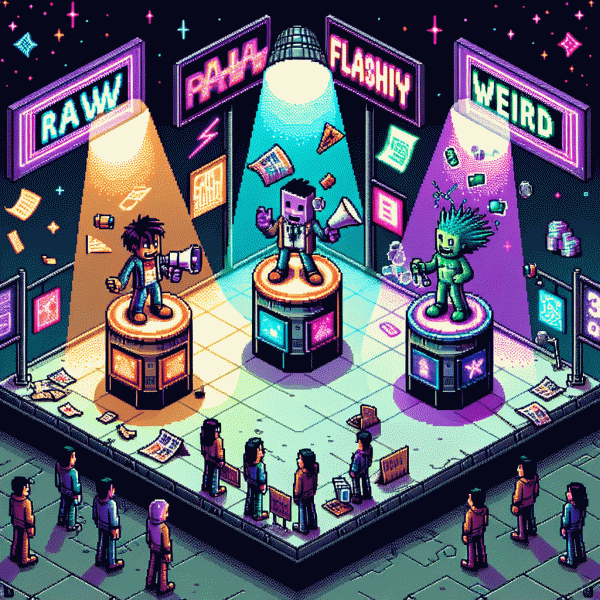
Raw That Rings True: Imperfect, honest, and impossible to ignore
People lean toward the messy, the real, the parts of a brand that show sweat and personality. A badly-lit clip of a team high-five, a candid caption about hiccups, or a product test that fails but teaches—these are attention magnets because they feel human. Raw content doesn't pretend to be perfect; it earns a second look.
Make it actionable: film one behind-the-scenes minute per week, caption it with a candid lesson, and ask a simple question that invites overlap with your audience's life. Use UGC and reply publicly to two honest complaints a month — visibility turns imperfection into credibility. Small, repeatable rituals beat a one-off viral stunt.
Expect trade-offs: raw will divide some viewers but convert the ones who stay. Metrics shift — shorter watch times can coexist with deeper comments and more saves. Track sentiment and retention, not just surface vanity numbers. When a piece resonates, amplify it with light editing, not a full makeover; preserve the voice that drew people in.
Treat authenticity like a laboratory: test micro-formats, measure which honest beats spark action, then double down. Train your team to document, not gloss—capture flubs as content, then frame the lesson. The result? A brand that feels alive, earns trust, and cuts through the noise without needing a neon billboard to prove it.
Flashy That Pops: Polished spectacle built to stop the scroll
Think of glossy creative that punches through noise: saturated color, kinetic cuts, and a confident idea that screams 'look now'. Flashy work is engineered to interrupt — it borrows theater lighting, billboard tempo, and soundtrack instincts so your thumb pauses. The goal is a micro-moment of delight that leads to action, not just admiration. Treat every frame like a headline and every second like ad real estate.
Build it with a five-frame blueprint: hook, surprise, benefit, quick demo, and prompt. Use bold typography, high-contrast palettes, tight pacing, and kinetic cropping to create instant legibility. Sound is optional but high-impact; design for mute with captions and exaggerated visuals. Keep file sizes sensible so load time doesn't kill the pop and so impressions actually finish.
Use this polish when you need scale, awareness, or a bold reposition; otherwise let raw or weird run experiments. A shiny spectacle can ring hollow if the tone mismatch is loud, so pair polish with a genuine brand cue. Test creative variants aggressively: headline swap, color shift, tempo trim. Measure micro-conversions — 3-second view, tap, or share — and amplify what moves the needle.
Quick checklist to ship a scroll-stopper: 1) hook in the first 1–2 seconds, 2) readable captions for mute feeds, 3) single clear CTA, 4) thumbnail that promises the action. Iterate fast: swap a color, trim 200ms, or test alternate edits and thumbnails. Keep it playful — witty polish outruns sterile perfection, and a brave pop can start a meaningful conversation.
Weird That Works: Quirky hooks that make brains do a double take
Outlandish hooks force the brain to pause and file a new folder called Interesting. Use that pause. The trick is to create a tiny surprise that does not derail comprehension: a visual mismatch, a sentence that rewires expectation, or an odd pairing that makes the reader tilt their head. When done right, oddity becomes the magnet that pulls attention from scroll to story.
Play with voice and context. Give an object a personality, turn a common verb literal, or lift a phrase out of an unrelated world and drop it into yours. Bold the mismatch so it registers fast. For example, describe a scheduling app as if it were a therapist for procrastination. The formula is simple, repeatable, and oddly humanizing: unexpected metaphor plus emotional clarity equals memorable.
Make the experiment measurable. Run short headlines against a control, track time on card, clicks, and micro conversions. Start with a single strange element, keep the value proposition explicit, and let metrics decide how weird to go. If attention rises but conversions stall, adjust the weirdness dial down or anchor the oddity with clearer benefits.
Know the boundaries. Quirk can amplify a raw brand or cut through flashy noise, but it can also confuse if misaligned with audience norms or platform context. Test on high-impression, low-commitment placements first, then scale winners into hero creative. Use weird as seasoning, not the only ingredient; let it highlight substance rather than replace it.
Quick playbook to steal: generate three offbeat hooks, run rapid microtests, keep the one that grabs attention and drives action. Weird should make brains do a double take and wallets do a single action. When that happens you have not only a laughable line, you have a conversion engine that people actually remember.
Score the Showdown: Simple tests to prove what wins with your crowd
Stop debating and start measuring. To find out whether raw, flashy, or weird wins with your crowd, run tiny, fast experiments that trade bravado for data. Pick one clear KPI — watch time, CTR, or conversions — and state a simple hypothesis: Raw will boost authenticity signals, Flashy will drive immediate clicks, Weird will increase share and recall. Aim for 500 to 2,000 impressions per variant and run each test 48 to 96 hours depending on traffic.
Set up a clean A/B/C test where creative is the only changed variable. Use identical captions, CTAs, targeting, and posting windows so the algorithm does not prefer one treatment for noncreative reasons. Monitor primary KPIs plus micro signals like comment quality, save rate, and rewatch percentage. If traffic is low, extend the window and rotate posts so each creative gets fair exposure. If a variant starts to outperform early, log the lift but do not scale yet; confirm with a repeat test to avoid fluke wins.
- 🆓 Raw: Behind the scenes clip or unscripted cut with a human hook; measure watch time and authentic comment ratio to judge depth.
- 💥 Flashy: Polished short with bold animation and punchy CTA; watch CTR, landing conversion, and first second retention.
- 🤖 Weird: Odd hook or surreal visual that breaks pattern; track share rate, comment virality, and virality coefficient for network effects.
Make decisions by movement, not muscle memory. Declare a winner when the lift on your primary KPI is sustainable and the cost per acquisition remains acceptable. Then iterate by combining winning elements, testing pacing and thumbnail variants, and keeping a simple experiment log with dates and results. Scale winners gradually, kill losers fast, and repeat: over time the data will tell you whether your crowd prefers raw truth, theatrical polish, or delightful oddity.
The Hybrid Hack: Blend raw, flashy, and weird for unfair advantage
Mixing authenticity, spectacle, and a dash of the unexpected is not a trend, it is a competitive move. Start by locking a single truth your audience cares about, then plan three layers that play off each other: honest voice, attention-grabbing polish, and a quirky twist that breaks patterns. The payoff is simple — trust hooks attention, attention magnifies reach, and weirdness turns reach into conversation.
Anchor: Capture an unedited moment or a plainspoken line that proves you understand the customer. Keep it short and human. Amplify: Add a glossy cut, a bold visual, or a sound design lift so that feeds pause. Make that production bite-sized so the raw bit still feels real. Twist: Drop one unexpected element — a playful metaphor, a visual gag, or an uncanny detail — that makes people tag friends.
Practical setup: shoot a 10–15 second raw clip, splice in a 3–5 second flashy highlight, and close with a 2 second weird stinger. Budget a starting split like 70% raw, 20% flashy, 10% weird for creative time. Measure watch retention, click rate, and reshares to see which layer earned loyalty versus just clicks.
Run a seven day hybrid test, iterate on the twist that boosted shares, and treat that pattern as a repeatable module. This is how small teams punch above their weight: emotional truth, high velocity polish, and a single oddball move that makes people care enough to act.