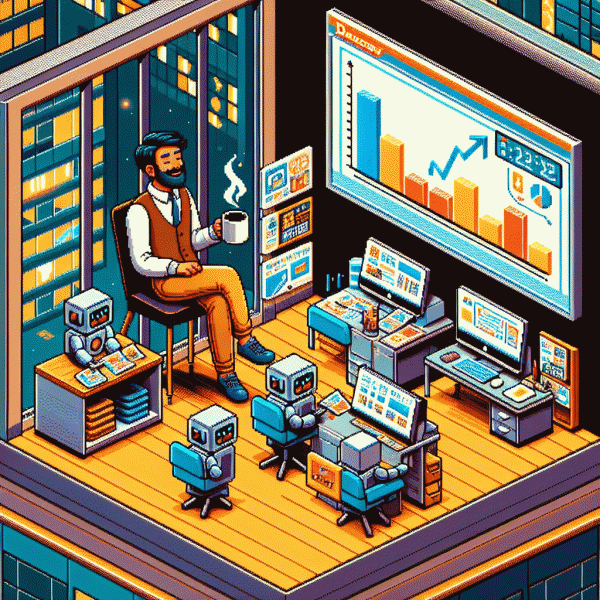
AI in Ads: Let the Robots Handle the Boring Stuff — Watch Your CTR Climb While You Sip Coffee
Set It and Nearly Forget It: The Right Way to Turn On Smart Automations
Flip the toggle, breathe, and let the algorithms do the heavy lifting — but don't walk away like you've hired a robot and retired. Smart automations are your ad account's intern who actually improves over time: they test headlines, nudge bids, and pause underperformers so your CTR inches up while you enjoy that extra cup of coffee. The trick is to set thoughtful boundaries and a clear objective, not to hand the keys to a wild experiment.
Start with a crisp goal: is CTR the north star, or are you optimizing for CPA or ROAS? Label the campaign, pick an evaluation window (7–14 days is a good lab), and give the system room to learn by avoiding too-frequent manual overrides. Use conservative budget ramps and frequency caps at the outset — automation learns faster when signals are steady. And set alert thresholds so you're notified, not surprised.
Match the automation intensity to your risk comfort with simple presets you can actually explain to a teammate:
- 🤖 Conservative: slow budget increases, strict caps on bid changes, longer learning window — ideal for stable brands.
- ⚙️ Balanced: moderate exploration on creatives and bids with mid-length learning cycles — good for growth without drama.
- 🚀 Aggressive: fast scaling, wide creative exploration, higher variance — use only with clear attribution and plenty of data.
Keep human + machine workflows: review top-performing creatives weekly, prune low-volume variants, and lock in brand-safe language. Run a shadow experiment where automation suggestions are logged before they're applied so you can audit decision paths. Those small governance moves prevent costly surprises while preserving the speed advantage.
Bottom line: automate the tedium, govern the strategy. Start small, monitor with smart alerts, and let the AI tune bids and creatives — your CTR will thank you, and you'll actually have time to sip that coffee.
From A/B to A/Z: Creative Testing at Warp Speed (Without Burning Budget)
Stop treating creative testing like a polite tennis match between two ads. When you want breakthrough CTRs, you need volume and speed — but with budget smarts. Shift from single-split experiments to rapid combinatorial tests: break each creative into headlines, visuals, CTAs and offers, then let an algorithm mix-and-match. The point isn't chaos; it's controlled exploration.
Start small and automated: atomize assets into interchangeable parts, feed 20–200 micro-variants into your testing engine, and use batch schedules so winners get more airtime instantly. Set simple rules: kill variants after X impressions with Y% under baseline, and promote anything that beats baseline by Z% within N hours. This reduces waste and surfaces real creative winners fast.
Stretch budget with adaptive allocation instead of flat A/B spends. Multi-armed bandit style rules mean your spend flows to better-performing variants automatically, so you stop funding dead weight. Use conservative floor caps to avoid premature consolidation, and reserve a small percentage of budget for exploration every week — the next big creative often shows up where you least expect it.
Finally, instrument ruthlessly: track micro-conversions, creative-level CTR, frequency, and audience overlap. Export the winning atoms into a creative playbook and automate production of scaled variants. Do this and you'll go from tinkering to running A/Z experiments that actually move the needle — while you get back to the important work of sipping something and plotting the next creative win.
Budget Magic: Bids, Pacing, and Spend That Adjust Themselves
If your daily ritual includes refreshing dashboards and staging small rebellions when budgets overshoot, it's time to let the smarter system take the wheel. Modern bidding engines aren't fortune-tellers — they're pattern-finders that react to auction-level signals in milliseconds, shifting spend to placements and audiences that actually engage. By automating dayparting, micro-bid tweaks, and cross-campaign pacing, the tech replaces guesswork with consistent allocation and frees you from manual firefighting.
Start by giving the algorithm clear rules, not vague wishes. Define CPA or ROAS targets, set floor and ceiling bids, and create audience pools the model is allowed to touch. Choose a sensible learning window so the system sees enough conversions to learn, and avoid flipping strategies mid-cycle — abrupt changes reset learning and waste budget. Pair automated bidding with light guardrails: budget caps per creative group, minimum conversion counts, and seasonal overrides.
Pick a pacing style, then let the system iterate:
- 🆓 Conservative: Small daily budget, tight CPA targets, slow but reliable scaling that protects margin.
- 🐢 Balanced: Moderate spend with flexible ROAS goals, prioritizing steady growth and steady learning.
- 🚀 Aggressive: Larger budget and looser bid limits to accelerate volume and shorten the learning curve.
Monitor like a pilot rather than a micromanager: scan headline metrics every 24–72 hours, export learnings weekly, and only tweak constraints when data justifies it. The result is cleaner experiments, higher CTRs and conversion rates, and a lot less late-night tweaking — you get better performance and more time to focus on creative strategy (or actual coffee breaks).
Stop Spreadsheet Babysitting: Alerts and Rules That Do the Nagging
Stop babysitting spreadsheets and let the automation do the nagging. Set up rules that watch CTR, CPA, impressions and conversions so you only get poked when human judgment is actually needed. Think of it as delegating the tedious treadmill to a small fleet of obedient robots.
Start with simple, specific rules that act like trained sensors: CTR below 0.5%: pause variant; CPA above $50: trim budget; CTR spike + low CPA: scale budget by 20%. These clear, numeric triggers remove ambiguity and speed decision making.
Implement alerts with sensible windows and cool down periods. Use a 3-day rolling average to avoid reacting to noise, add a 24 hour cool down after an automated change, and chain rules so scaling up does not conflict with pausing logic. Test rules in a holdout campaign before wide deployment.
The payoff is immediate: faster fixes, fewer missed winners, and more time to sketch creative tests or sip coffee. Automation catches anomalies at 2 AM, flags odd creative drift, and frees your team to iterate on strategy rather than babysit cells and formulas.
Rollout checklist: 1: pick 3 core metrics, 2: create conservative thresholds, 3: monitor performance for one week, and 4: tighten or loosen rules based on outcomes. Let the robots nag; you keep the creative veto.
Keep the Human Edge: Where Strategy Beats the Algorithm
Let the automation babysit the boring bits — humans keep the strategy. Machines will crunch bids, predict micro-moments, and slice audiences, but they don't feel your brand's awkward charm, sense cultural friction, or choose which small risk will win attention. Your job is to translate business goals into a clear playbook: target the right people, pick the metric that actually matters, and declare the single idea every creative must defend. Add timing, context and stakeholder alignment and you're already ahead.
Practical moves: start every campaign with three crisp hypotheses, a headline that doubles as a promise, and one hard constraint (budget, creative length, or legal must-have). Inject customer empathy into segmentation — micro-segments reveal different triggers — and use AI to generate dozens of variants. Then apply your human filters: tone, truthfulness, cultural fit, and whether the concept could backfire in a meme-fuelled world. If a machine proposes a clever angle that feels off, don't shrug — interrogate it and trace why it got generated.
Build a human-in-the-loop workflow: prompt templates that nudge AI toward brand-safe outputs, a shortlist of trusted headlines, and a twice-weekly review where a real person rejects or escalates suggestions. Keep an ethics checklist and a catalog of failures so you don't repeat the same mistake. Treat AI like an enthusiastic junior who needs mentoring: give feedback, mark failures, and turn winning outputs into reusable prompts so the system learns your taste without overruling judgement.
Measure what matters and keep experiments short. Run controlled tests for CTR, but also track downstream signals like retention, conversion velocity and sentiment — those are where strategy outmuscles raw optimization. Use holdout groups so gains aren't just noise, iterate weekly, retire ideas that plateau, and celebrate learning publicly. Do those things and you'll get smarter ads, higher CTR, and actually more time to sip coffee while watching humans win where algorithms can't.